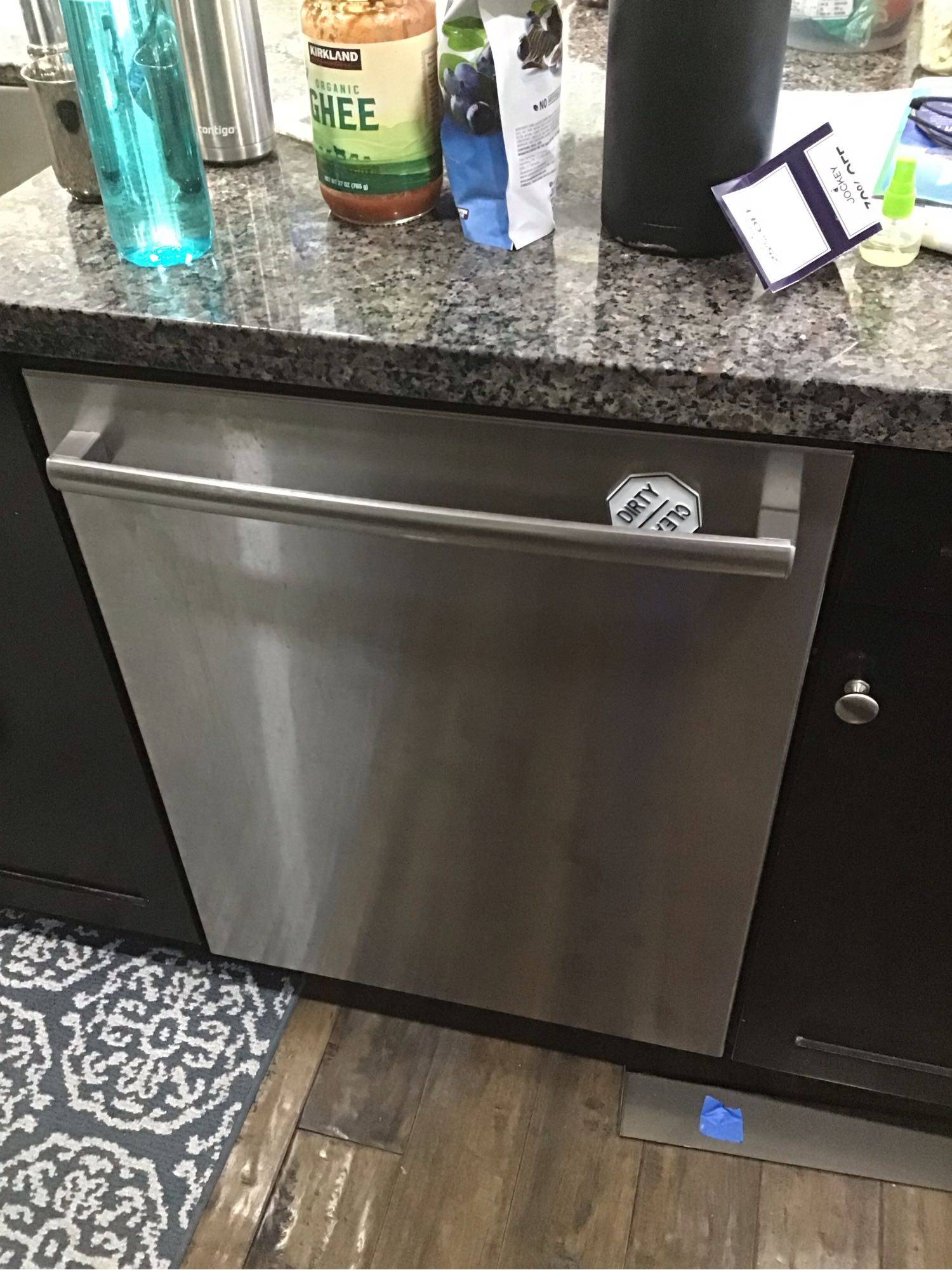
Cloudy film on glassware after a full dishwasher cycle is often dismissed as a minor inconvenience, but repeated buildup usually points to a deeper imbalance in how the appliance manages heat, minerals, and rinse performance. When rinse aid is already in use and the problem persists, the cause is rarely cosmetic. It tends to be mechanical or related to water chemistry.
One of the most common factors is insufficient final rinse temperature. Dishwashers rely on high heat in the last phase of the cycle to evaporate water quickly from glass surfaces. When the heating element underperforms or the thermostat reads incorrectly, water remains on the glass longer than intended. As it dries slowly, dissolved minerals are left behind as a cloudy layer. This is especially visible on transparent glassware, where even a thin deposit becomes obvious.
A related issue is unstable water heating during the cycle. Some units heat water at the beginning but fail to maintain consistent temperature during rinsing. This can happen due to aging heating elements, faulty temperature sensors, or control board inconsistencies. The result is uneven drying conditions across the load, which explains why some items come out clear while others look permanently hazy.
Water quality plays an equally important role. Hard water contains high levels of calcium and magnesium. When the dishwasher does not fully neutralize these minerals, they bond to glass surfaces during drying. Rinse aid helps reduce surface tension, but it cannot compensate for heavily mineralized water. In such cases, the film is not grease or detergent residue, but a microscopic mineral layer that builds up gradually with each cycle.
Ion exchange systems or built-in water softeners, when present, can also affect results. If the softener resin is exhausted or not regenerating properly, the dishwasher effectively operates without protection against hardness. This leads to progressive clouding even when detergent and rinse aid usage remains unchanged.
Another contributing factor is improper detergent balance. Excess detergent can leave alkaline residue on glass, which appears as a dull haze. Insufficient detergent, on the other hand, prevents full breakdown of food particles, which then redeposit on surfaces during rinsing. Both scenarios create a similar visual effect, making diagnosis more complex without inspection.
Mechanical circulation issues also deserve attention. If spray arms are partially blocked by debris or limescale, water distribution becomes uneven. Some items receive strong rinsing flow, while others are only partially cleaned. This inconsistency often shows up first on glassware because it reacts more visibly to mineral residue than ceramic or stainless steel.
Filter buildup at the base of the dishwasher can intensify the problem. When water recirculates through a clogged filter, microscopic food particles and dissolved minerals remain in the system longer than intended. During the final rinse, these particles can settle back onto glass surfaces, contributing to a dull finish.
Rinse aid systems themselves are not immune to faults. A blocked dispenser or incorrect dosing setting may reduce the effectiveness of surface tension control. In such cases, water does not sheet off glass properly, leaving droplets that dry into visible spots. Even when rinse aid is present in the reservoir, incorrect delivery can make it ineffective.
Environmental factors also play a role. Extremely low inlet water pressure affects rinse performance, reducing the force needed to remove remaining detergent and minerals. Similarly, very short eco cycles often prioritize energy savings over final rinse temperature and duration, which increases the likelihood of cloudy results.
In many situations, the issue is not a single failure but a combination of small deviations: slightly lower temperature, moderately hard water, and partially restricted spray flow. Together, these conditions create a persistent haze that standard cleaning products cannot fully resolve.
When clouding becomes consistent across multiple cycles and loads, technical inspection becomes necessary. Checking heating performance, water hardness settings, circulation efficiency, and rinse aid dosing accuracy helps isolate the root cause rather than treating the symptom.
For persistent cases of cloudy glassware and suspected heating or water quality system issues, professional diagnostics ensure the appliance is evaluated under proper operating conditions and restored to stable performance.
In such situations, it is advisable to order service from the San Diego Appliance Repair Center to assess internal components, recalibrate the system, and restore proper wash and rinse balance.